Building countertop software in a development environment is one thing. Building software that creates real value on the fabrication floor requires input from people who actually fabricate countertops every day.

Lloyd with Colonial Granite in Virginia, our flagship fabricator development partner, has played an important role in helping us develop and refine the StoneShopPro Countertop Design Solution.
His real-world fabrication experience has helped us troubleshoot issues, evaluate workflows and stay focused on what matters to the stone shop.
Lloyd has consistently emphasized two priorities:
Create measurable value for the fabricator.
Never compromise accuracy for automation.
Those principles are helping define how we develop the Countertop Design Solution.
#1 — Create a Sellable Visual Representation
Our first objective is straightforward:
Help the fabricator sell the countertop project.
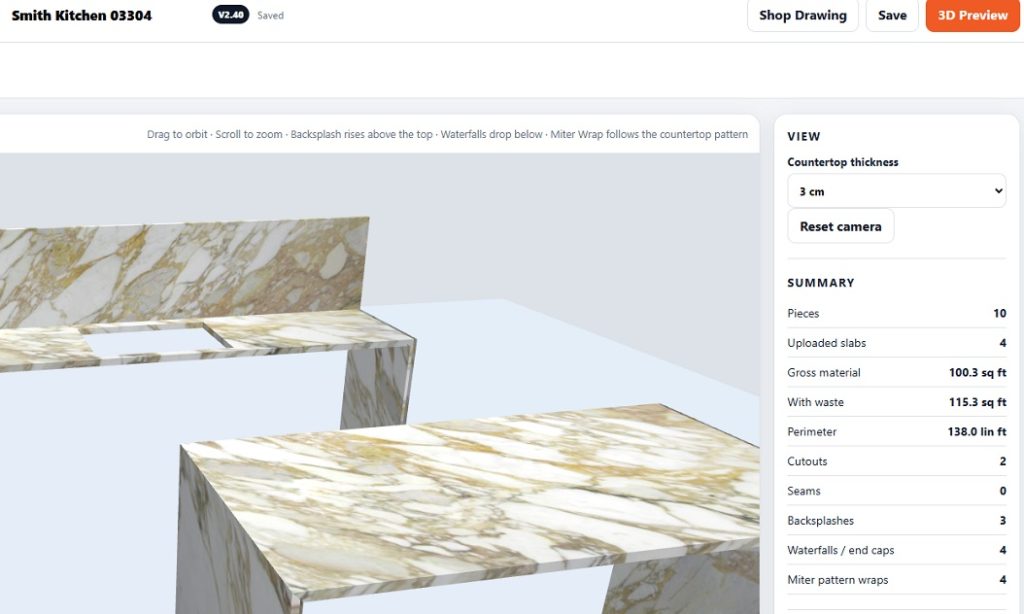
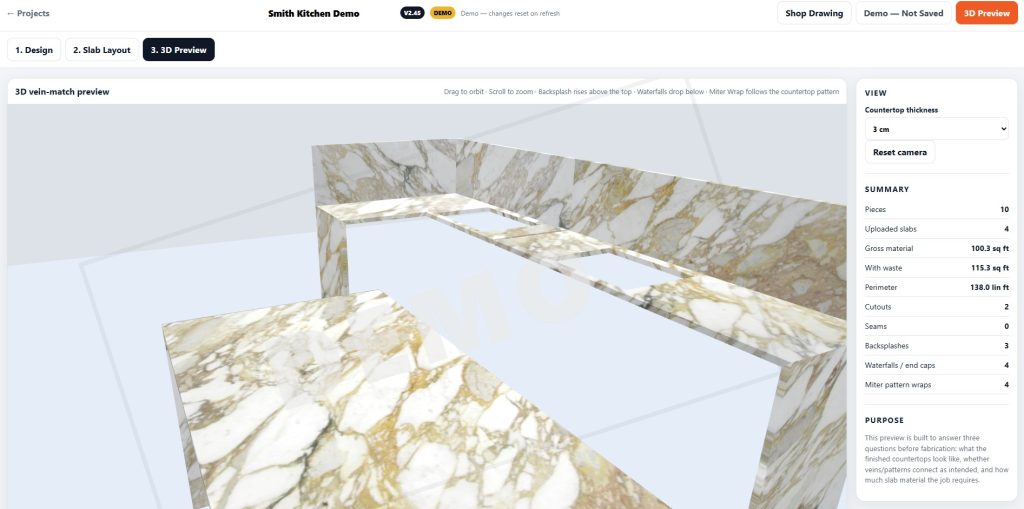
Starting with a digital template, project layout and photographs of the actual slabs, StoneShopPro is being developed to create a realistic representation of the finished project.
The goal is for the customer to see their countertops before fabrication—including:
- Actual slab placement
- Vein and pattern positioning
- Seams
- Sink and cooktop cutouts
- Backsplashes
- Waterfalls and end panels
- Finished countertop geometry
The customer and fabricator can work from the same visual representation before the stone is cut.
Digital Template → Slab Layout → 3D Visualization → Customer Approval
That workflow creates immediate value for the fabricator.
It can help communicate the design, set expectations, demonstrate craftsmanship and give the customer greater confidence in what they are purchasing.
#2 — Earn Production Accuracy Through Real-World Comparison
Our longer-term objective is considerably more ambitious:
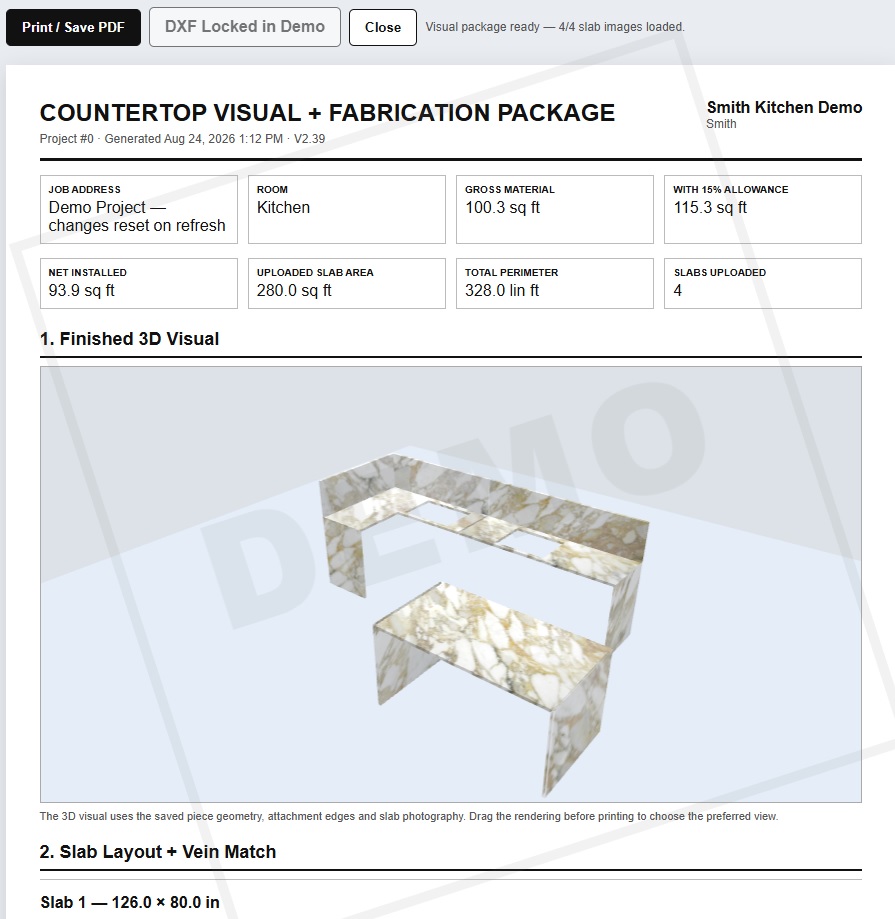
Digital Template → Slab Layout → 3D Rendering → Production-Ready DXF
But production automation requires a much higher standard than visualization.
We do not intend to simply generate a DXF file and declare it ready for automated fabrication.
Accuracy has to be demonstrated.
During the initial development and validation period, we recommend that fabricators compare StoneShopPro-generated DXF files against the production files created through their established workflow.
For at least the first 10 production attempts, the generated files should be carefully compared.
StoneShopPro-generated DXF files should not be used for automated production without independent verification during this validation process.
We want to identify discrepancies—not hide them.
Those comparisons provide valuable information about:
- Dimensions
- Geometry
- Cutouts
- Seams
- Edge conditions
- Offsets
- Piece orientation
- DXF structure
- Fabrication requirements
Feedback from Lloyd, Colonial Granite and future StoneShopPro fabricators will help us continuously improve the system.
Hundreds of Real Jobs Matter More Than a Successful Demo
Ten successful comparisons are a starting point—not the finish line.
Before we represent automated DXF generation as a proven unattended production workflow, our objective is to accumulate hundreds of verified real-world fabrication runs.
Every comparison gives us another opportunity to measure accuracy, identify edge cases and improve the software.
The development path is deliberate:
Sell with visualization → Compare → Verify → Correct → Repeat → Establish Accuracy → Production Automation
Software Built With Fabricators, Not Just For Them
StoneShopPro is being developed around the realities of running a stone fabrication business.
The 3D visualization component can create commercial value today by helping fabricators present and sell their work.
Production automation is different.
It has to earn the fabricator's trust through demonstrated accuracy.
We appreciate Lloyd and the team at Colonial Granite for being willing to challenge the software, identify problems and provide the practical feedback necessary to build a Countertop Design Solution that stone fabricators can ultimately be proud to use.